Friday, November 20, 2009

Reflection: weeks 9 & 10

Weeks 9 and 10 were a little different than past weeks in the way that instead of doing eye-openers we have been working on our advocacy projects. 

In week 9 we started out by learning about advocacy.  We did this by getting into groups and teaching the class different topics related to advocacy.  This was an interesting way to learn and an interesting way to teach as well.  Most groups did some kind of skit to illustrate their point.  I learned that advocacy is not a service and that it doesn't always have to be really confrontational.  It was interesting learning about the barriers to advocacy because they all made sense.  I think I'm most guilty of not knowing enough about an issue, but that is something I could totally change if I just took the time! 

We also found our political leaders online and all of their contact information.  Something that surprised me about this was they that they did their email.  Most representatives didn't have an actually email address, but more like this blank form you would go to their site and fill out.  I guess it makes sense considering how many emails they must get, but I was kind of just expecting to find an email address like any other individual would have. 

In week 10 we watched the first section of a documentary called "Unnatural Causes".  The section was called "In Sickness and In Wealth" and was about health and how it seems to be directly correlated to wealth.  It's pretty upsetting to see how life expectancy goes down with level of income.  It was also a really big eye-opener to see how much stress is put on people who earn less, or people who are in less control at their jobs.  I never expected that.  When I think about stress, I definitely was thinking that the hospital CEO must be under a lot of stress, way more than a janitor.  It was crazy to find out that that's not the case.  My book kind of ties into this as it's talking about how we are constantly stressed because we are constantly working for security.  I guess I can see that a CEO with more security than a janitor would have less stress.


We also discussed the upcoming photo essay.  This is a pretty cool idea!  I can't wait to see everyone's ideas.  Photo essays should be used for more projects in more classes.  It's way more interesting to not only the person completing the project, but also for those viewing it!  I plan on making naturally cleaning solutions out of things like baking soda and vinegar and testing how well they clean! Pretty exciting stuff! 

Tuesday, November 17, 2009

Eco-Chic Lifestyle Change Week 7: Weekly Update

My SMART Goal: To use reusable bags 100% of the time I shop.

Success Rate: 100% success rate this week!

The Week: This week I did not use any plastic bags!  I went shopping a few different times, but I was always prepared because I bought one of those fold up Superone bags that I now keep in my purse, and I also carry two reusable bags in my car.  Me and a friend went shopping at the thrift store and the grocery store and we were sure to use our reusable bags each time.  We also went to Caribou where I noticed they have those bags that fold up into themselves and look like hacky sacks!  They were like $9 so I think I can find one cheaper if I keep my eyes peeled.

Lessons Learned: I learned that it's easy to succeed at your goal when you come prepared and it feels good too!

Next Week's Plans:  I think I'd like to keep my goal the same.  I'm also still looking for cute bags for my mom and sister so if anyone sees any around town let me know!


Monday, November 16, 2009

Advocacy Project: Healthy People/THOMAS

I looked under the goal "Reduce illness, disability and death related to tobacco use and exposure to secondhand smoke" and used the Healthy People 2010 objective 27-2: To reduce tobacco use by adolescents (grades 9 -12).

As of the midcourse review use of all different kinds of tobacco (cigars, cigarettes, smokeless tobacco) has moved toward the target goal of change by 68%.  Black non-Hispanics have the best rate.  White non-Hispanics have the worst out of the group (with a 50-99% disparity from the best group).  Hispanics are in the middle (with a 10-49% disparity from the best group).  There is no data on other races.  Females were listed as the group with the best rate and males were listed as having a 10-49% disparity from the best group. 

 Although progress has been made towards the goal there are still some emerging issues.  Smokeless tobacco was listed as an issue.  This may be because sometimes these products can be seen as less harmful then other tobacco products.  However this is untrue because these products are known human carcinogens and they are still addictive and harmful to your health.  Another emerging issue is the use of the internet to market tobacco products.  It is very hard to police the internet and many sites use weak or non existent age verification methods.  This has set back the goal of reducing the proportion of adolescents and young adults who are exposed to tobacco advertising.  If that goal has setbacks it adversely affects the success of my goal. 


H.R.1432: To reduce youth usage of tobacco products, to enhance State efforts to eliminate retail sales of tobacco products to minors, and for other purposes.
Sponsor: Rep Blackburn, Marsha [TN-7] (introduced 3/11/2009)      Cosponsors (4)
Committees: House Energy and Commerce
Latest Major Action: 3/11/2009 Referred to House committee. Status: Referred to the House Committee on Energy and Commerce.
Recommendation: Vote YES for H.R. 1432
My Political Representative(s):

Friday, November 13, 2009

Read 'n' Seed 4: Third Quarter of "The Last Hours of Ancient Sunlight"

The third quarter of "The Last Hours of Ancient Sunlight" had a different feel than the first half of the book.  I read pages 192 to 285.  This incorporated about 12 chapters.

In the first part of the book the author discussed all of the issues that earth and the world's population are facing such as the oil crisis, lack of clean accessible water, famine, war, deforestation, global warming etc.  In the second part of book the author describes how we got to this critical point on the verge of destruction.  Finally, in the third part of the book the main topic was what we can do about it.  

This third section of the book is probably my favorite.  It's much more upbeat than the other two for obvious reasons.  Instead of talking about the downside of our situation, it talked about what can be done to try and reverse what's happening.  It addressed more spiritual and cultural things we need to address verses tangible things.  One thing I learned is that we are all connected by something called  a "morphic field".  It's hard to explain, but as I understood it it's kind of like this huge collective unconscious.  This means if individually we start to change our way of thinking it can echo out in the larger world.  When enough people learn to think differently there will be a snap or shift and our culture will change.  The interconnectedness of all things is something I find somewhat difficult to grasp, but I love the idea of it and I want to believe that it's true.  The author also talked about practicing "small acts of anonymous mercy".  These have a synergistic effect.  The more random acts of kindness performed, the more people will be inclined to act in a kind manner.


The idea of the interconnectedness of all things gives me a feeling of equality to all living things.  Some humans believe that we are superior to all other living things and that it is our right to dominate over all of nature, but what does that mean?  That we have a right to use everything, in any amount, and however we would like with no thought or question as to how it effects other living things or future generations?  I believe that we are the earth's stewards, not the earth's tyrants.  I recently read a chapter out of a book called "What Color is Your Parachute" in which the author describes life as individual moments in which you have the power by the decisions you make whether or not to bring more gratitude, more kindness, more forgiveness, more honesty, and more love into this world.  Everyday we live these moments whether we are conscious that these decisions are being made or not.  I feel that if everyone believed that with each decision they made they had the chance to bring more or less love into the world we would all try a little harder.  I feel like this is sort of the point that the author of my book was trying to get across as well.    

Wednesday, November 11, 2009

Eco-Chic Lifestyle Change Week 6: Weekly Update

My SMART Goal: To use reusable bags 100% of the time I shop.

Success Rate:  I would give myself a 90% success rate this week.

The Week: Well, it would have been a perfect 100% but I went to the grocery store last night with a classmate because we have to bring snack to a class.  We took her car and I didn't even think to grab reusable bags.  She didn't have any either and we got quite a few items so we each ended up using a paper bag.  However, we each cut down on the amount of bags we might have used by carrying the jugs of juice instead of using another bag.  This was the only time I went shopping within the last few days.  I have noticed that now that I have a couple of reusable bags I tend to find a bunch of different ways to use them!  For instants, I will be carrying the snack for the health 4000 class in them.  I also use them as gym bags, laundry bags, and carrying my school stuff! 

Lessons Learned: I learned that the biggest barrier in successfully completing my goal is not having a bag on hand.  I keep a fold up bag in my purse now, but not in my backpack, which was why I was not successful this week.  It would be worth it to buy another fold up bag to keep in my backpack so I always have one on hand. 
Next Week's Plans:  I think I want to keep my goal the same (since I've only been successful once or twice).  However, I did have a brain storm here that I really want to get my family members using reusable bags.  I know my mom would totally be into the idea if I got her a cute little fold up one for her purse and my sister loves purses and bags so I think I could get her to use them at the grocery store!  Looks like I'm on the hunt for some cute bags!    

Blogged for the Eco-Chic Lifestyle Change Week 6 hosted by Amy@Eco-Chic with Amy


<--way cute


Blogged for the Eco-Chic Lifestyle Change Week 6 hosted by Amy@Eco-Chic with Amy


Monday, November 9, 2009

Advocacy Project: My Political Representatives

President Obama  -   Democrat  http://www.whitehouse.gov/

The White House
1600 Pennsylvania Avenue NW
Washington, DC 20500   

Comments: 202-456-1111
Switchboard: 202-456-1414
You can fill our a form to email the president, but no email address is listed. 

Jim Oberstar - House Congressmen- Democrat - http://oberstar.house.gov/ 

 http://oberstar.house.gov/index.asp?Type=B_LIST&SEC={AF74BAFF-6820-45D4-81A6-E450E544722C
The above website has all of Jim's contact information.
You can fill out a form to email him.  


Amy Klobuchar - Senator Congresswoman - Democrat - http://klobuchar.senate.gov/

 http://klobuchar.senate.gov/contactamy.cfm
The above link has like 10 different addresses and phone numbers in 10 different locations you can reach Amy at.  You can fill out a form to email her.

Toll free number:      1-888-224-9043

Al Franken - Senate Congressman - Democrat - http://franken.senate.gov/


http://franken.senate.gov/contact/
The above website contains Al's contact infromation and a form you could fill out if you'd like to email him.

Governor Tim Pawlenty  - Republican-  http://www.governor.state.mn.us/ 


Mailing Address:
Office of the Governor
130 State Capitol
75 Rev. Dr. Martin Luther King Jr. Blvd.
St. Paul, MN 55155

Other ways to reach our office:
Telephone: (651) 296-3391
Toll Free:    (800) 657-3717
Facsimile:   (651) 296-2089
E-mail:        tim.pawlenty@state.mn.us

Legislators   -   http://www.leg.state.mn.us/

http://www.house.leg.state.mn.us/members/housemembers.asp
The above link has all the names, phone numbers, party information, and emails of the members of the house members.
http://www.senate.leg.state.mn.us/members/member_list.php?sort=a&ls=#header
The above link has all the names, phone numbers, party information, and emails of the member of the senate.

St. Louis County Board    -   http://www.co.st-louis.mn.us/slcportal/SiteMap/HomePage/ContactUs/tabid/552/SiteMap/HomePage/Departments/CountyBoard/tabid/554/Default.aspx

The St. Louis County Board does not list anyone as their president, however the board includes 7 members which represent the 7 different districts in the county.  Those board members contact information can be found on that link including name, address, phone number, and a link to email them. The site also includes times and dates that the board meets.

Mayor of East Grand Forks MN - Lynn Stauss http://www.ci.east-grand-forks.mn.us/city/mayorbio.php

600 DeMers Ave • P.O. Box 373 « East Grand Forks, MN 56721
218-773-2483 • 218-773-9728 fax


This was the most information I could find on my hometown mayor.  I couldn't find an email address or a political affiliation.  The website I provided is a lackluster attempt at a biography.  Oh, small town politics!  However, I do know where he lives (a few blocks from my house) and it wouldn't be hard to find his home phone number in the yellow pages I'm sure.

Wednesday, November 4, 2009

Reflection: Weeks 7 & 8

Weeks 7 & 8 brought up some very interesting subjects that I hadn't really been exposed to.

In week 7 we watched a video called "Green".  The video concentrated on cities that sat on the banks of the Mississippi in the southern part of the states, a place dubbed "cancer alley".  It received this nickname because of all the huge chemical production plants that also situated themselves on the Mississippi.  These chemicals are leeching into the water, and into the air, and dramatically decreasing the quality of life for the members of the communities surrounding them.  These communities face higher rates of cancer, asthma, and other negative health effects.  The people affected cry out for help from their local and state government, and from the companies producing the problems, but are ignored.  Their very legitimate concerns are pooh-poohed, and dismissed with hardly a thought.  Why?  Because the companies are making a profit, because the companies have the power, the wealth, and the voice, because they think of these communities as expendable.  Well I think these communities are people like everyone else and no one can put a price on a life.  No one can make the decision that a certain population is disposable.  This documentary highlighted environmental racism, that is the idea that those of lower socioeconomic status and living in minority communities are more exposed to harmful environmental afflictions.  This is in part because rules and regulations are loosely enforces at best for this industries of pollution.  This documentary really lit my injustice light.  How can these things be happening?  And on top of that, how can these things be ignored?

After the movie we were put into two groups: those representing the chemical production companies, and those representing the affected communities.  I was placed on the side of industry.  It was hard to do but when I started thinking as if I were in their shoes it's easy to see why they do it:  they get away with it, they aren't affected by it, and they make a profit.  I would think at some point morality and ethics would set in, but clearly that is not the case.  It's just so hard to change this cycle of injustice.  What can anyone do?  I feel just as powerless as those communities.  I honestly believe that before anything changes, our culture has to make some big changes.  Anyway, the video gave me a lot to think about, and a lot to be thankful about as far as the quality of air I breath and the quality of water I drink, things I would normally take for granted.

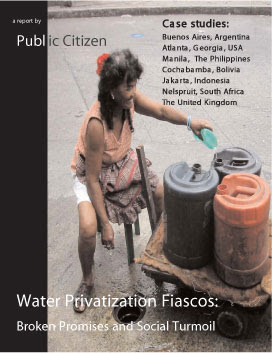
In week 8 we watched another documentary called "Thirst".  This film shed some light on the privatization of water issue that's taking place around the world.  I had no idea this was even an issue until this past Monday.  Although the video gave us a good idea of what's happening I still have so many questions!  How can anyone "own" the water supply?  Whose is it to sell off in the first place?  Why dose the world bank have their claws in EVERYTHING?!  It really sucks that water privatization is happening in the states, but it's even more under handed that it's happening in places like India.  How is it that companies like Coca Cola, and Pepsi are draining water right from under homes in India and then selling it back to them for profit?  Water being more expensive for these people than milk is out of control.  I just loved how the video showed individuals in higher positions saying things like "We will sell the water at affordable prices".  How do they determine what is affordable for some of the poorest people on earth?  I just get so ticked off when I see all these big figure heads from the world bank and such places making these decisions.  I mean they live a pretty cozy life, so they don't stand to lose anything from the decisions they make about water rights and rather are bound to make profitable gains.  I found a really comprehensive article on water privatization and in it, it says, "Fortune magazine has predicted that "water is the oil of the 21 century" and corporations are rushing to invest in the water business."  It also stated that, "The World Bank predicts that by 2025, two-thirds of the world's population will suffer from lack of clean and safe drinking water."  I think we all better start standing up for our right to water for life and not for profit before we have to pay an arm and a leg to boil macaroni noodles, or make kool-aid!  My favorite quote from the film was by the man from Bolivia. He said "The people united will not be defeated."  Considering the water crisis that may be in our near future these seem like appropriate words to take to heart. 

Eco-Chic Lifestyle Change Week 5: Weekly Update

My SMART goal: To use reusable bags 100% of the time I shop.

Success Rate: If I had to put a percent on it I would say that I was 80% successful this week.

The Week: I had a few challenges this week among the successes.  The challenge was running out of room in my bags.  I only have 2 reusable bags currently and I went on a colossal grocery store journey this weekend.  This wasn't a problem until I was trying to fit everything I bought into two bags.  Needless to say it was mission impossible and I ended up needed to use 2 paper bags, darn :( At least it was a bag-your-own-food kind of store so I had the option to use as few bags as possible and we do often reuse paper bags at our house to contain our massive recycle pile so I know this bags will be put to use!  As far as successes go, I bought a new pair of boots and I made sure to tell the cashier that I could just carry the box so that's one less bag floating around out there!

Lessons Learned: This week I learned that it doesn't hurt to have a few extra reusable bags.  I'm still on the hunt for a fold up bag that can fit in my purse.  I also learned that sometimes it's okay to use paper bags if you have another purpose for them. 

Next Week Plans: Well, for next week I will continue on with this same goal.  I don't plan to modify it.  However, if anyone knows where to find a cute reusable fold up bag just send that information my way!

Just a little side story:  When my roommate Hailey and I lived in England for those 9 months we would often go get our groceries using our huge backpacks we used for traveling (pictured below).  It was easier to handle one backpack then several bags on the bus and much easier when you had to carry all those groceries for about a mile after you got off the bus!  Total bag savers!  


Sunday, November 1, 2009

Eye Opener: Junk on the Brain

Part 1: Definitions
Antique - any piece of furniture or decorative object or the like produced in a former period and valuable because of its beauty or rarity
Antiquing - Any method used to give a surface an aged or antique look.
Junk - trash: dispose of (something useless or old); "trash these old chairs"; "junk an old car"; "scrap your old computer"
Flea Market - A flea market or swap meet is a type of bazaar where inexpensive or secondhand goods are sold or bartered. It may be indoors, such as in a warehouse or school gymnasium; or it may be outdoors, such as in a field or under a tent. ..
Thrift Shop - A shop which sells used goods (especially clothes) at low prices
Upcycling - Upcycling is a component of sustainability in which waste materials are used to provide new products.
Resale Shop - All shops which sell gently-used goods are resale shops

Part 2:  Q & A
What do the terms above have to do with environmental health?
Well, they are helping to support good environmental health.  They represent the idea that there are many uses for any one item and reusing is recycling, and recycling is reducing, and reducing production is saving resources.

Identify at least one local resource for each of the terms above...provide name, location, contact info, and link to website or blog.
Antiqes - Father Time Antiques

395 S Lake Ave
Duluth, MN 55802-2303
(218) 625-2379  (no website) 
Flea Market- I couldn't find any in Duluth, but I found a website that lists a bunch of Minnesota Flea Markets  http://www.fleaportal.com/FleaMarketPortal/_criteria/_Minnesota_flea-markets.aspx
Thrift Shop - Goodwill  
www.goodwill.org

700 Garfield Ave
Duluth, MN 55802-2695
(218) 722-6351 
Resale Shop - Plato's Closet
www.platoscloset.com

5115 Burning Tree Rd
Duluth, MN 55811-1876
(218) 733-9455
Upcycling - I couldn't find any resources here in Duluth that directly say "Upcycling" but through my search I found out that the term was coined by a German chemist Michael Braungart and architect William McDonough in the book they wrote called "Cradle to Cradle: Remaking the Way We Make Things".  

Identify whether you do any or use any of these things. Why or why not?
I do use some of these things.  I mean I occasionally shop at places like Savers and Goodwill (especially for some good cheap books).  I also go to flea markets and atique stores from time to time with my friends.  However, when I go to these stores it's usually for something pretty specific like books, or an end table for the living room or old jewelery in the case of antique stores.  I don't like to shop for clothing or shoes at many of these places because it's so hit or miss.  Also, places like Plato's Closet aren't always that much cheaper than places like target.

Part 3: Getting my junk on!

I really liked this project because I thought it was very innovative and I loved the old "antiqued" look of the chipped paint on the railing.  Also, the main message in this project was that sometimes you have to keep turning an object around before you can find a perfect use for it, which was totally the case with this old piece of railing.


I think why I like this one so much is because it's something that I've helped a friend of mine do who is all about antiquing and turning out things into usable objects.  This window frame is something you could probably find at a garage sale or maybe you even have one lying around your house already.  It just totally give it new life and purpose! Just awesome! 


This was by far my favorite project! I love jewelery and most of all I LOVE old jewelery.  What is great about this is you kind of get to piece together your own!  I mentioned early that why I like to go to antique stores is to look at jewelery; I never thought that I could take all the little trinkets I find and make them into my own pieces.  I am really excited to go to some antique stores and look for pieces I can make into my own jewelery!

Share & Voice: Having an Eco Friendly Period

So, it never occurred to me until my Women's Health Issues class last Tuesday how much waste is accompanied by our monthly periods.  We went to the Women's clinic in Duluth where our speaker was talking to us about birth control methods and how it can seem unnatural to have something way up next to your uterus (Nuvaring, IUDs). This is an understandable barrier that some women face before deciding on a certain type of birth control.  This brought about the conversation of periods and how many women use tampons, which we don't really see as unnatural.  However, our speaker brought up the point that tampons really aren't naturally.  Often they are made with synthetic materials (the applicators), pesticides are used in the growing of the cotton, and lets face it, they're white because they are bleached.  I mean we've come a long way since the 1930s when toxic shock syndrome was a serious concern, but we still have to be concerned with the amount of waste we're producing. I found this statistic: In your life, you will probably use around 11,400 tampons (5 days X 5 tampons X 38 years).

Here are some eco-friendly alternatives to tampons and pads: (click on them to learn more)


Our speaker also mentioned something she called a Tulip that was kind of like the keeper and the Divacup, but it closed up like a tulip when you pulled it out, therefore less mess.  I wasn't able to find it on line anywhere, but it sounded like something worth looking into! 

Friday, October 30, 2009

Read 'n' Seed 3: Second quarter of "The Last Hour of Ancient Sunlight"

The second quarter of "The Last Hours of Ancient Sunlight" was much different than the first.  I read 7 chapters from pages 91 to 191.

The first part of the book was more about what's going on in our world with our environment.  It talks about the oil crisis, and deforestation, and climate change.  In the second quarter of the book the author is more focused on how we got to this point in the history of the world.  It's a lot of history involving more westernized cultures swooping in and taking over native cultures (such as the Inca's, and Native Americans).  The other main topic is younger cultures verses older cultures.  Again, that would be more like westernized cultures that seek to instate dominance over other cultures.  Pretty much these "younger cultures" gain by consuming the lives' of others.  They feel that they have a right to everything and that humans are superior to all other creatures and that everything on our planet was placed here to serve humans.  Older cultures on the other hand are the cultures that believe we are a part of the world, not rulers of the world, and that we are supposed to cooperate and live in peace with the rest of creation.

 I learned a lot of history in these chapters.  I learned quite a bit about Christopher Columbus.  He was a rapist, a murderer, and a thief who took advantage of primitive cultures by enslaving them and stealing their wealth.  There are so many misconceptions about Christopher Columbus and the fact that we give him credit for discovering American, teach this in schools, and have a day named after him is a bunch of bologna (in my opinion).  This is kind of a side tangent and has little to do with the environment, but it was in my book, and it was shocking and eye-opening, so I wanted to include it.

More relevant to this class I learned a number of things.  I learned that our population growth is out of control.  Here is a little scale of population growth from the book:
In 1960 there were 3,038,930,391 humans on earth.  That year the earth saw the addition of 40,622,370.
1961 - +56,007,855
1962 - +69,393,370
1963 - +70,987,231
If this many more people are born each year than die we are adding to our population dramatically.  This was about 50 years ago. In about 40 years we had doubled earth's population.  Each person who is born requires a certain amount of resources - 3 meals a day, a couple gallons of water, a certain ration of oil.  These are resources that won't last forever.


The implications of what I learned is basically that we don't really think about ourselves competing for resources in our day to day life, but we are.  We are competing everyday with the 6.6 billion other people who share this planet.  Our resources are far more scarce than we could imagine.  We are running out of oil, we are running out of forests, we are draining our aquifers.  We always think of America as the land of plenty and it is in comparison to many other places...but for how long?  We have a scary future ahead of us if we don't start getting realistic with our quickly disintegrating resources.

Thursday, October 29, 2009

Share & Voice: Enviro-Cool Blog Award

I received the Cool Blog Award from Danielle for my Share & Voice entitled Worry About More Than Just your Water Bottles.  Basically a woman who owned a health store came in and talked to us about supplements and herbal products.  She also talked to us about cosmetics.  She raised many issues that I'd never even thought of, opened my eyes to safety issues, and cleared up some of my concerns and uncertainties regarding some of these products.  It was really interesting and important stuff so I'm glad I could pass it on to everyone!  Thanks for the award Danielle!

I am passing the award on to Ashley for her awesome post on UMD's Smoking Policy Forum.  She recapped the forum really well and I think it's waaayyyy cool how she voiced her opinion, and was really a voice for many people on campus who feel the same way!  I applaud her courage! Everyone should check it out!

  • Leave a comment below so that I know you "picked up" the award.
  • Within 1 week, create a Share and Voice post that says you've received the award and indicate who the award is from (be sure to hyperlink).
  • Also indicate to whom you are going to pass on the award and why. Be sure to hyperlink the blogger (use main blog URL) and the blog title (use the specific URL for that blog post).
  • Copy and paste these instructions at the bottom of your post.
  • Publish the post.
  • Visit each blogger you've awarded and leave a comment telling them they've won. 
  • Continue the process...

Wednesday, October 28, 2009

Eco-Chic Lifestyle Change Week 4: Weekly Update

My SMART goal is to use reusable bags 100% of the time I shop. This week I completely succeeded!

I guess saying that I successfully completed my goal this week is kind of cheating because I was successful only because I didn't go shopping at all.  I mean there aren't really any challenges or issues with using a reusable bag when you don't go shopping!  I guess the only thing I learned is that not shopping at all saves bags and money?  I guess I just don't have a lot to share this week!

I think to help me improve on only using reusable bags I need to look for those kind that can fold up and have that snap on them that keeps them all folded up.  If I had one of those I could always keep it in my purse and would be far less likely to forget it! 

I totally need one of these sweet fold up reusable bags! ^

Blogged for the Eco-Chic Lifestyle Change Week 4 hosted by Amy@Eco-Chic with Amy.

Monday, October 26, 2009

Eye Opener: Environmental Working Group

This is a great eye opener because we just had a women come and talk to us about some safety issues involving cosmetics in my Women's Health Issues class. 


This kind of website sparks a lot of curiosity, so naturally I tried out a number of the products I use.  I tried eye shadows, concealers, lotions, and hair products.  The one I want to talk about though is the shampoo I use.  I use a shampoo (and conditioner) from the John Frieda collection.  Although I'm sure it switches, the exact one I'm using right now is called "John Frieda Sheer Blonde Lustrous touch Strengthening Shampoo".  This one was rated a 6, but other very similar shampoos of the same brand were more like 8s.  The only difference would be something like "Highlight Enhancing" or something like that and it would be an 8 and linked to cancer, so at least the one I'm currently using isn't linked to cancer!  When the ingredients were broken down fragrance was at the top with a score of 8 and a 100% data gap.  That really sucks because the main reason I buy the shampoo isn't because I think it does wonderful things for my hair, but because I like the smell!  I also learned that this product tests on animals because towards the end of the page under the section about cancer and developmental concerns they would list a substance and then say something like "One or more animal studies show reproductive effects at high doses."  There are so many things that don't even go through my head as a consumer when I'm at a store picking out shampoos, or eyeshadow. 

What was also really interesting was how they told you what percentage of the same type of product had lower concerns.  Between the handful of products I typed in all of them had a score at a 6 or above and had 60% of products with lower concerns.  How does that happen?  It appears that everything I choose is toxic!  Either I have bad luck, or I'm shopping in the wrong places!  I guess I can no longer be a blissfully ignorant consumer.  At least now with this website I can look into the safety of products before I buy them. 

Sunday, October 25, 2009

Reflection: Weeks 5 & 6

The last two weeks have been informative to say the least...
During week 5 we watched a movie called "The Future of Food".  This movie really stirred up a lot of questions for me.  Mostly about patents on nature and GMOs (Genetically Modified Organisms).  I mean honestly, this movie just made me so mad.  There is so much injustice in the agriculture industry and I had no idea.  My dad is a farmer in North Dakota and it just really hit home for me when I saw that farmer from North Dakota getting sued by Manosato.  It made me sacred for the future of my own family farm.  Something else that really grinds my gears is the fact that foods that have been genetically modified don't have to have that on their label.  Where's the LIABILITY?!  How are we ever going to know if these things have negative effects on our people if we aren't tracking them?  Corporations who push modified food act like it's going to solve world hunger when we know full well that it isn't necessarily lack of food that's the problem, but lack of equality.  There are just so many problems with our world today and thanks to this class many more are brought to my attention all the time.  It's just so frustrating.

For week 6 we watched a film called "Diet for a New America".  It wasn't too long, but it was interesting.  The narrator was the son in line to inherit the Baskin Robbins empire; however, he turned it down after realizing the negative health and environmental effects of the corporation (and many just like it).  He turned down millions, maybe billions, of dollars to stick to his beliefs which I think it pretty amazing.  I don't think I could be that strong.  Some things that stuck with me from this video was the part where they were just pulling this fatty white sausage link looking material out of the arteries of the heart.  GROSS!  It really freaked me out.  What are Americans doing to themselves?  I mean it's our culture.  To eat out, and eat whatever is convenient, cheap, and available in a hurry is our lifestyle.  It's going to take a lot of effort to change an entire nation's lifestyle, but still it's very important that it does change.  Something else shocking was the idea that there are 4 cows for every 1 person in America?  This provokes the question: how much cow is each individual person eating?  I mean, I don't have any exact statistics, but jeeze!  This video definitely forced me to take a look at my own diet and examine some things I might like to change. 

Thursday, October 22, 2009

Share & Voice: Worry about more than just your water bottles

In my previous share & voice I talked about Sharon Szukis, a herbalist, coming to talk to our class about supplements.  There is something else she talked about that I was completely unaware of that is really significant information, especially for women.  We talked about cosmetics.

The first thing you need to know is that everything you put on your skin, ends up being absorbed into your bloodstream.  This is in part because the skin receives 1/3 of the blood circulation throughout the body.  This is important information because I'd say most women use numerous products on their skin daily.  This includes things like lotion, shampoo and conditioner, body wash, shaving cream, face wash, lip balm, and concealers.  So what's in all those products you have to watch you for?  Paraben and Propylene glycol are both used as chemical preservatives and stabilizers and they are also products of petroleum.  The funny thing about petroleum is that when it enters a human body it mimics estrogen.  They are called xenoestrogen (xeno is a Greek prefix meaning foreign or strange).  In our culture today men and women already have way to much estrogen in their systems coming from animal products, breathing in car exhaust, the water we drink, and plastics leeching chemicals.  These xenoestrogens are the same thing we worry about with plastic water bottles and yet no one is telling us, "Stop putting on lotion."  Estrogen caused cancers (such as breast, colon, and prostate cancer) are at epidemic proportions in the U.S. and no doubt the rate will continue to rise.  Estrogen in men can also lower their sperm count which could account in part for why so many couples have trouble conceiving these days.  Although it was mostly in jest, Sharon said, "In the 70s, that was unheard of! Everybody was getting pregnant their first try!"


So of course when I got home from Sharon's talk I went through a bunch of my cosmetics and toiletries.  Sure enough I found Propylene glycol in almost all of them and at least 1 or 2 others in a list of synthetics to avoid she had handed out in class. Sharon mentioned that companies make products that don't include these harmful synthetics, but it's just more expensive.  She acknowledged that being college students on a budget we can't afford to throw out our whole stash of stuff to buy new, safer products.  She suggested instead to maybe choose one product that you use the most, or over the most surface area on your body, and when that one is gone spend the extra 2 or 3 bucks on an all natural product.

A few other things to think about that leech chemicals that you may be ingesting:
  • cooking pans - if your pans have a Teflon coating (or any other kind of coating) and it gets scratched and you continue to use it, you're ingesting that. Don't put these pans in the dishwasher!
  • Cooking at higher temperatures can leech toxins into your food.  Never cook on high!
  • Never use plastic wrap to cover your food in the microwave. Invest in some wax paper!
  • Just putting plastic containers in the microwave in general is bad.  It's just the same (if not worse) than leaving a plastic water bottle out in the sun and then drinking out of it. Use ceramic or glass in the microwave whenever possible!
 

Wednesday, October 21, 2009

Share & Voice: My Women's Health Issues class

We had an extremely interesting class period tonight for Women's Health Issues (an excellent class, everyone should take it!).  An herbal and supplement specialist and owner of "The Essence of Health" named Sharon Szukis came in and talked to our class.  I'm going to highlight all the most important/interesting things I learned. 

First off, something that might not be that well known is that the FDA doesn't really supervise herbal and supplement manufacturers.  There aren't really standards or guidelines for what they're throwing into their products.  This means we have to be really conscious, smart, consumers.  Fortunately, the majority of the larger, reputable supplement makers came to gather to make their own rules and regulations.  Basically they police themselves and hold themselves very accountable to high standards.  If you want to make sure you are getting supplements from these reputable supplement makers make sure somewhere on the bottle it's labeled "GMP" which stands for Good Manufacturing Procedure".  If it says GMP you know that the labels are accurate and you can trust the list of ingredients to be correct.  Now on herbal products you should look for something that says "Standardized" which will also guarantee you quality and safety.  Sharon also suggested that if you're looking for something particular like Vitamin C it's okay to go to Target or Walmart, or a grocery store; however, if you aren't sure exactly what you're looking for you should definitely go to specialty store because that's where the specialist are who can help you safely find what you're looking for.  She used the example of a person on blood thinners who might not realize that some herbal products thin your blood.  This could be a dangerous combination, but a combination that would likely be avoided by going to people who know, and do this for a living.  Also in line with being a smart consumer you should be weary of supplement and herbal products that come from China because China's manufacturing is known as being ahead of their policing.  Not always safe!

Sharon also told us that only around 5% of the population get the very basic vitamins that the body need.  That means 95% of us aren't even getting the basic, bare minimum of vitamins.  In light of this, she said that if she could suggest 3 supplements for women to take it would be a good multi-vitamin, calcium, and vitamin D.  Calcium is especially important  for those who drink soft drinks or any carbonated drinks because the carbonation is done with the use of phosphorus which basically eats away the bones.  On top of that caffeine interferes with calcium absorption.  I, myself have a bit of a soft drink problem so after hearing Sharon talk I'm already working on cutting down.  Vitamin D is also extra important for those of us way up north here (males and females)!  Vitamin D is intrinsically tied to our immune system and a deficiency in this vitamin is DIRECTLY linked to colon cancer, breast cancer, and prostate cancer.  Just some really interesting things to look in to! 

Tuesday, October 20, 2009

Eco-Chic Lifestyle Change Week 3: Weekly Update

My SMART goal is to use reusable bags 100% of the time I shop.  I only slipped one time.  I don't exactly have a percent success rate, but I'd just say fairly well.

The only time I failed was because I was out of town and did not have my own car.  I also did not think to take one of my reusable bags with me; however, I did remember to ask them for paper so I can feel a little better about that :)  I also forgot a bag at the grocery store when I was just picking up a few items, but thanks to my overly gigantic purse I was able to avoid a bag once again! Success!  Purses are also quite reusable, haha!

I learned this week to be more assertive when people are trying to bag your stuff.  I know it sounds like a funny lesson learned, but why shouldn't you say, "I don't need a bag, thanks".  I've also been just getting used to the idea of bringing my own bag with me when I shop, or using my purse. Being more mindful was part of my plan from last week and I feel as though I've really worked on that.

I really have nothing to change.  I feel like I'm doing a good job and I feel like the more I work on this SMART goal the more it will just become second nature.  I will keep working on the mindfulness thing!


Blogged for the Eco-Chic Lifestyle Change Week 3 hosted by Amy@Eco-Chic with Amy.

Friday, October 16, 2009

Read 'n' Seed 2: First quarter of "The Last Hours of Ancient Sunlight"

So far I've read the first quarter of my book, which has equaled out to 90 pages.  This translates into 8 chapters.  Mainly the author has focused on how the world has gotten to the state of complete ecological collapse.  We're running out of oil, we're cutting down all the trees (therefore running out of oxygen), we're running out of food (on land and in the oceans), and cheap and clean water may be an item of the past. To be honest, thus far the book is quite the downer.  It's interesting and important information, but it makes our current ecological crises look hopeless.

I learned a bit about the Carboniferous Period.  It occurred 400 million years ago and lasted about 70.  It was called the Carboniferous Period because there was significantly more carbon in the air during that time then there is today.  Also, the temperature was quite a bit higher than it was today.  Due to those conditions plant life grew like crazy!  The author described the vegetation as rising hundreds of feet in the air! This vegetation is what eventually would turn into fossil fuel (millions of years later).

I also learned that the U.S. only contains 6% of the population but uses 25% of the world's energy.  That's a pretty sucky statistic.  It's also desturbing that we are cutting and burning down our rainforests (thousands of acres every hour) when they are our major source of oxygen and carbon dioxide removal.  Still we continue to destroy them.  Another startling fact is that TB, a disease most people associate with third world countries, is alive and well even in the U.S. and kills more people each year than AIDS, malaria, and tropical diseases combined. 

So what are the implications of what I've read? The book pretty much says that unless we change our culture, and change the way we think we're going to destroy everything we have and I totally believe it.  So much of what we rely on just for day to day survival is on the brink of collapse and we still have a government unwilling to recognize it.  All and all, this book is painting a rather terrifying picture of the earth (or lack there of) in the very near future.  Most of the problems he's discussed in the book are likely to occur in our lifetime...scary.  We need to change

Check out this really realistic video about the end of the earth: http://www.youtube.com/watch?v=nZMwKPmsbWE

Thursday, October 15, 2009

Share & Voice: BigBelly Solar Compactor

We all make trash and then that trash has to be collected.  Well what if it had to be collected less often?  Less frequent collections would mean reducing carbon emissions from giant waste management trucks.  How do we make this happen?  Well UMD already is!  Our campus, along with many others across the nation, have started to use something called a "BigBelly Solar Compactor".  This thing is the smartest trash can you'll come across!  As it fills with trash it uses the power from its solar panels to compact it.  By compacting the trash right where it sits BigBelly goes from a normal garbage can holding 35 gallons to having the ability to hold 150 to 200 gallons of trash!  Not only that, but it sends a text to the city when it's full and needs to be collected!  No extra trips and it frees up city workers to do other things.  Besides having BigBelly trash cans, the campus also has BigBelly recycling bins.  This is great for all the same reasons as the trash can, but the added bonus of street recycling!  You don't see as many recycling bins when you're walking down the street as you do trash cans, that's for sure; however, BigBellies are a part of the solution.  Look for UMD's BigBelly Solar Compactor outside the Sports & Health Building!


One group who has had a lot of success with the placement of BigBellies throughout their city is Philadelphia. They're estimated to save $875,000 a year!  Check out BigBelly for yourself, all the information came right from their website!   http://www.bigbellysolar.com/